

Recently, I got a new doctor.
Before that, I’d had the same doctor since I was a little kid. She knew that I would do my own research and feel confident in a course of action before coming to her, and she would support me in whatever decision I made for my own health.
So when I started feeling overwhelmed by anxiety in 2021, she agreed to put me on the medication of my choice.
When she retired, I was handed off to a new doctor.
My brand new doctor spent about 5 minutes with me and then slid an ADHD assessment across the table and told me that I was treating symptoms, but we should treat the cause instead.
The whole situation is a distorted reflection of what I see in digital marketing these days.
Being online has become homogenous.
Boring.
A place full of sameness. This report from Microsoft on The Impact of Generative AI on Critical Thinking cites this feeling of everything sounding the same as “mechanised convergence”, because people are using AI tools to ask the same questions, therefore getting the same answers.
Collectively, we’ve been treating the symptoms of this disengagement in our audiences with more content, more sales pitches, more videos.
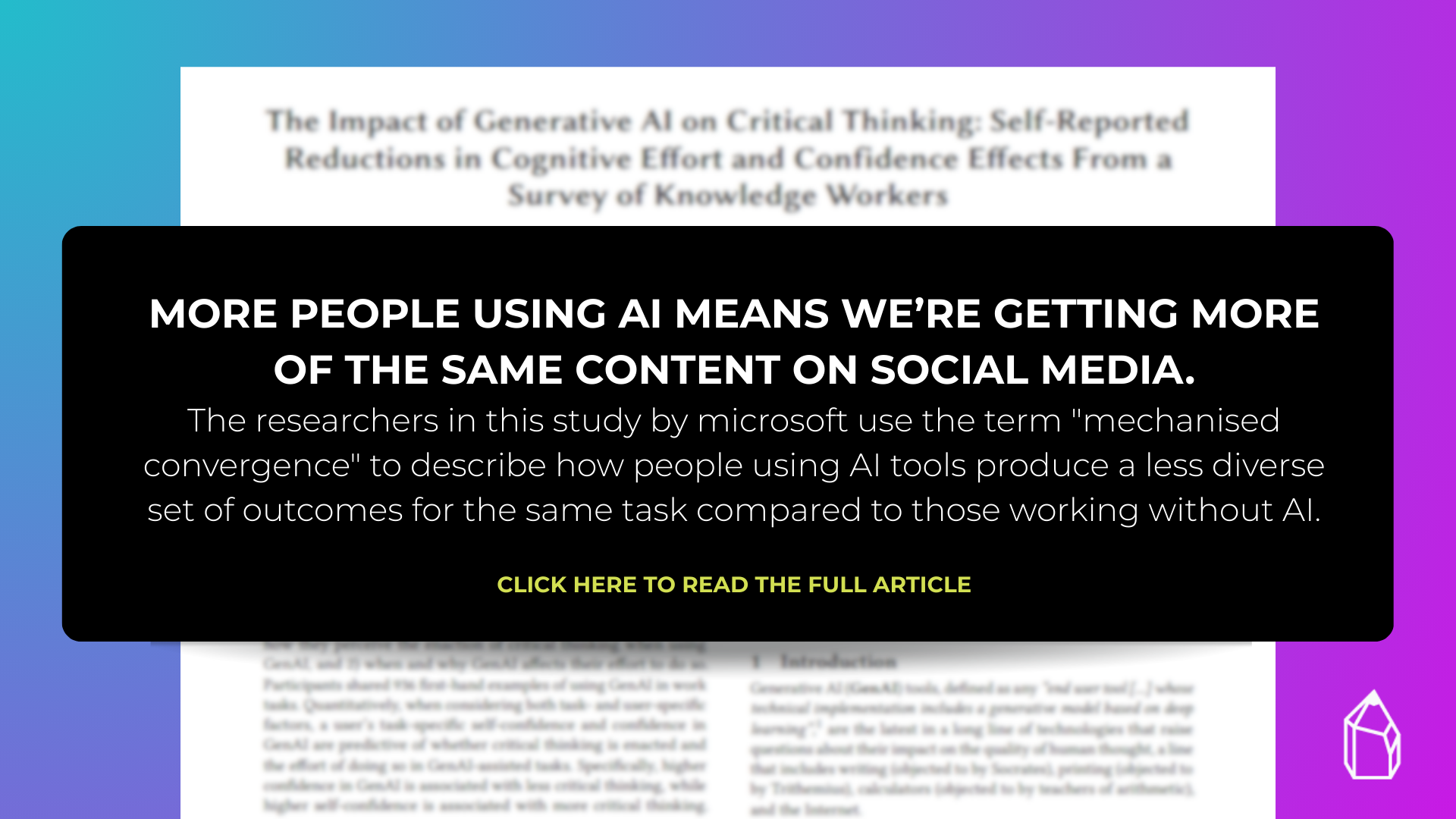
“…motivated primarily by the observation of the tendency of AI-assisted knowledge workflows to be subject to “mechanised convergence” [114], i.e., that users with access to GenAI tools produce a less diverse set of outcomes for the same task, compared to those without. This tendency for convergence reflects a lack of personal, contextualised, critical and reflective judgement of AI output and thus can be interpreted as a deterioration of critical thinking.” (Source)
If you start on AI, instead of starting with your own thoughts, you risk putting out content that sounds the same as everyone else. Strategy and personal expereince is still required in digital marketing.
Sometimes the easy solution is the problem.
When I asked to be medicated for anxiety, I was guilty of going for the easiest solution. I’d heard the tales of how hard it was for a woman over 30 to get diagnosed with ADHD, so I took the easier path and focused on the symptoms I could control.
As a digital marketer, it’s a part of my job to find the easy solutions for my clients. When they’re trying to connect with their audience and increase their organic reach on social media.
I see similar symptoms for many of them:
It’s getting harder to sell services and products organically on social media.
It’s getting harder to get attention from the right audience.
It’s hard to figure out what to post about to promote your business.
The things I used to do aren’t working as well anymore.
These things are true for everyone right now. And it’s leaving people feeling exhausted by their marketing efforts.
So we go online and try to find an easy solution, because there is too much going on for us to try something any more complicated.
The kind of advice people are giving each other is, in my humble opinion, doing more damage than good. Just this week, I’ve seen people say:
“Just train ChatGPT to speak like you and get it to write your captions.”
“Get AI to write your voice-over script.”
“Here’s a program that will re-create your voice so you don’t need to do your own voice-overs.”
“Just use AI to write your speech; no one will be able to tell when you’re saying it.”
“You should get this program to do your profile picture so it looks more professional.”
“You should put up a blog on your website. Just generate 5-10 blog posts and put them up.”
Lack of confidence in yourself and your messaging is the root problem. Reflexively reaching for AI is just a symptom.
As a content manager, it’s my job to take my client’s ideas every month and execute social media content, newsletters and blog posts that connect with an audience and answer questions about my clients.
No matter what industry they’re in, they all have a depth of expertise and passion for what they do, which fuels our content strategy every month.
They know how important it is to create content that is within their comfort zone, that also provides information and quick wins for their ideal audience.
No matter the industry, one thing remains the same.
AI is not adding anything to their knowledge and expertise. But it does try to homogenize their messaging.
When service providers reach for AI instead of relying on the well of knowledge that got them where they are today, they’re letting fear of imperfection rob their audience of the little tidbits that come from writing down their thoughts.
And while my clients have monthly meetings to remind them that they’re the expert and that the people following them want to connect with them as a person, I can’t help but think that many business owners don’t have someone to give them this advice.
As a result, we're slowly but surely losing access to their voice, their knowledge, and the life experiences that make their expertise unique and impactful.
Their audience, in turn, is losing interest, and their organic reach is feeling the impact.
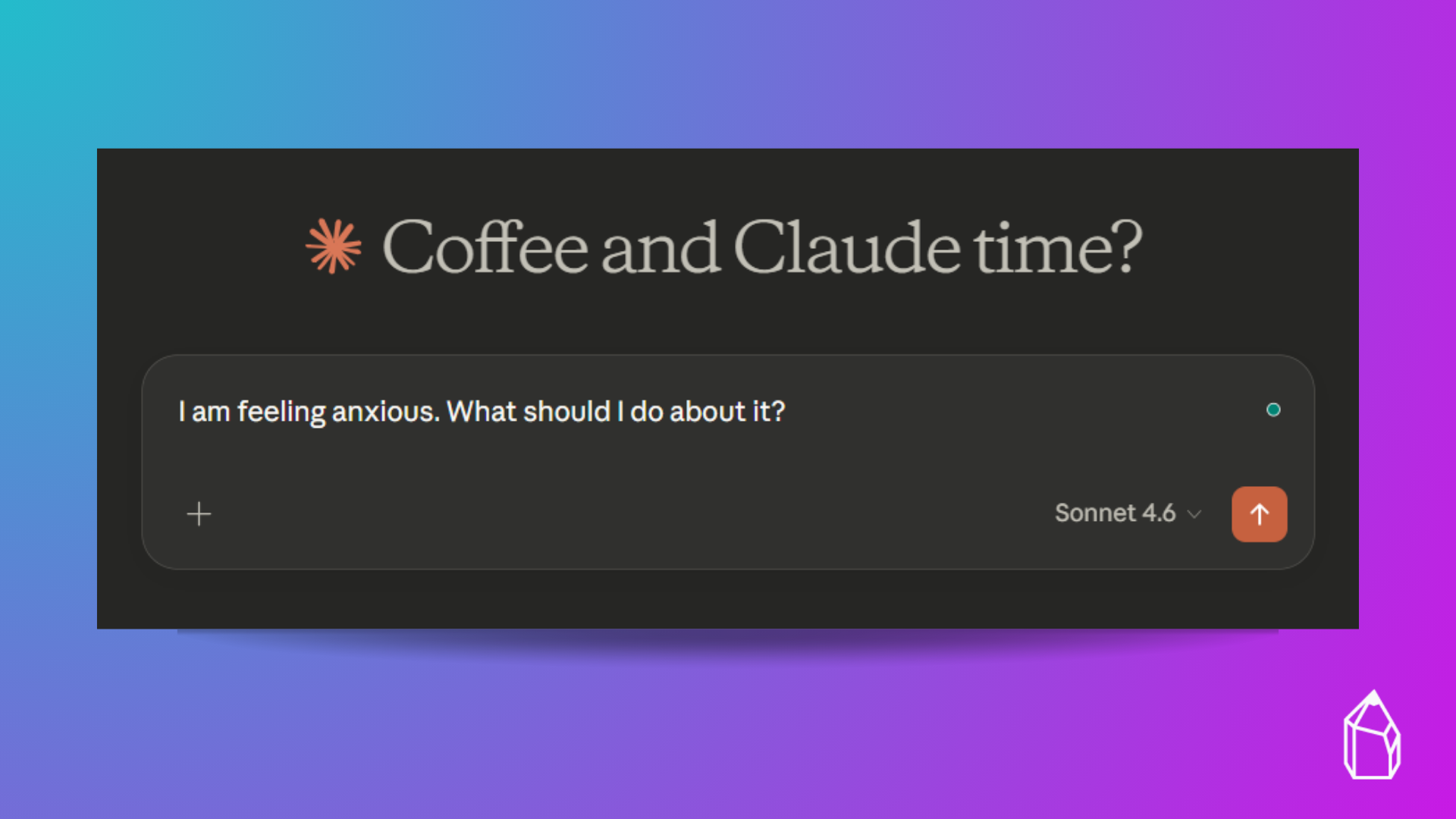
I have to wonder if ‘I asked Claude’ holds the same connotation as ‘I looked it up on WebMD’ for doctors these days.
We are turning to AI to treat the symptoms through more content generation. But we should be focused on refining the message instead.
When I decided to get treatment for anxiety, I will admit that I absolutely went to Dr.GPT to figure out if I was barking up the right tree before I went to my real-life doctor.
And, doing what it does best, it validated me. It made me think I had all the answers and that I was on the right path.
When I went to my Doctor, who was admittedly pretty close to her retirement, she wrote me a prescription that I’d learned to request from a chatbot and sent me on my way.
In retrospect, instead of asking questions and trying to find out the root issue, she became the middleman of my health care.
Whenever you reflexively go to a chatbot to write your content for you, you’re doing the exact same thing.
The problem with that reflexive belief that a chatbot knows better than you is that you sacrifice your voice for an artificial sense of security.
It’s understandable that for people who haven’t invested in writing as a skill, it can feel like AI makes content creation more accessible.
But I always warn my clients against this. The best content that I work on each month starts with my clients' raw thoughts and ideas.
Sometimes they’re handed to me as a bulleted list of thoughts, and sometimes I get a 45-minute voice note to translate into a blog post.
But those pieces stand out because even if I feed that voice note into an AI to type out for me, I can say ‘don’t change a single part of their voice’ and the piece I get started with is so uniquely them, it makes the final content read as human.
Which makes their human audiences pay attention.
It’s easy to forget, with how accessible AI is, that the person making the buying decision is a human being. Not a robot. (Further reading: Content Used to Be King. Now ‘Proof of Humanity’ Reigns.)
Reading a newsletter or a blog or a social media post drafted by AI makes audiences feel like they’re talking to a middleman, for an expertise that doesn’t belong to the author anymore.
Because while they might have written the prompt, and it’s their story and their thoughts, the homogenous writing style takes all of that uniqueness and sacrifices it for the sake of ‘better’ writing.
And people can tell when things have been written by AI. Even when it’s edited.
It can lead your audience to ask: Why would I go to a person for a service or expertise I can just get from a chatbot for free?

“Some participants shared examples in which they thought critical thinking was unnecessary because their use of GenAI tool is secondary (14/319) to their goals. Likewise, participants do not enact critical thinking when the task is perceived to be trivial and insignificant (55/319), such as writing social media posts (P239) and meeting minutes summary (P271).” (Source)
Would you feel compelled to buy from a business that sees communication with you as trivial and insignificant?
The easy solution might make you feel like you’re getting things done, but investing time will address the cause rather than treat the symptoms.
During my introduction session with my new Doctor, she reviewed my medical history with me. And upon landing on my medications list, she focused on asking me questions about what caused my anxiety.
She dug deep to understand the symptoms I was treating. And she very quickly surmised that for someone who spends a lot of time researching, learning and connecting concepts for clients, the days when I wasn’t getting work done would be the root cause of my anxiety.
She didn’t switch my medications because she thought the course my previous Doctor had agreed upon was wrong. And she warned me that switching from an anxiety treatment to trialling ADHD medications would be much harder. She warned me that it could take months to find the right cocktail for my brain.
But it was important. So I decided to invest the extra time.
The role of social media has shifted. And investing time in connecting online addresses the problem, not just the symptoms.
As a digital marketer, I am not opposed to specific uses of AI in business.
I work on retainer, so it’s my job to fit as much work as possible into each month’s budget for my clients. There is a whole list of things that we use it for to save time.
If you're on a limited budget and you can't afford to hire someone for your content management, it's understandable that you would want to use a free resource instead.
But before you reflexively start with AI, like all the AI-first marketing companies are telling you, remember the pieces of your credibility you give up when you don't start with your own knowledge.
Overuse of AI in marketing is just a symptom.
Believing in your expertise is harder than checking in with a chatbot, and writing your unique perspective takes time, but it’s worth treating the root problem.
I’ve been on my ADHD meds for about a month now, and it has been admittedly hard. I know I have many doctor's appointments ahead of me to get the right concoction to make my brain work at its best.
But I’m already seeing a huge payoff for the effort.
I’m writing for my own business again, and I’m getting my work done on time. I’m staying focused for 8+ hours, which has allowed me to open up my schedule to take on more retainers. I’m going to networking events again and connecting with people in person.
It’s a lot of work, but just like in marketing, the effort pays off exponentially.